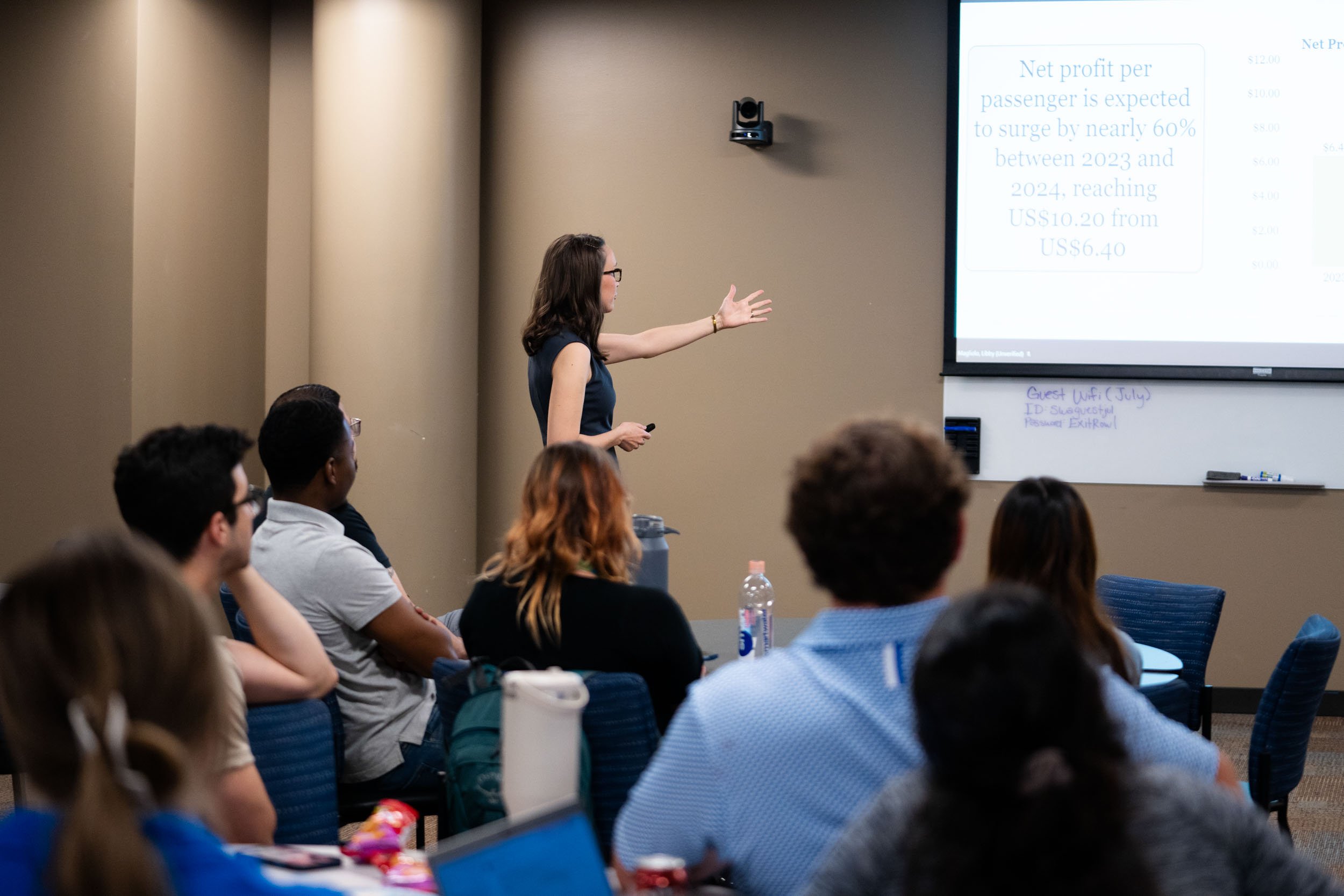
Where leadership development programs quietly fall short: teaching rising leaders to communicate like one.
In research on where leadership development falls short, the answer wasn't strategy or skill. It was almost always communication, rising leaders who know the business cold but still get lost in the details the first time it really matters.
That's because the instinct that got someone into your program (deep expertise, thorough analysis, showing their work) is the same instinct that works against them the first time they present to an executive audience. Nobody ever taught them the shift.


When done right…Your program builds communicators who get noticed.
An effective presentation is more than pretty slides. The story a participant tells, and how quickly a senior audience can act on it, is what gets remembered back in the business.
That skill isn't something people pick up in school or on the job. I teach your participants how to structure their thinking, curate their message, and walk into a high-stakes room with confidence that comes from real preparation, not personality.
What does it look like when your team can confidently create an effective presentation?

Visible program outcomes
A program gets judged by what participants do differently back at their desks. Communication skills show up fast, often in the very next meeting, making this an easy win to point to when leadership asks what the program produced.

Retention you can defend
Investing in a rising leader's communication signals the company is betting on them. Gallup's research backs this up: engaged employees are more likely to stay, and can increase company profits by as much as 23%.

Fewer fires for you to put out
When a participant can't structure a message, your inbox hears about it first, a scrambling director, an executive asking why the deck isn't ready. This skill means fewer of those calls land on your desk.
Give your leadership program the communication piece it's missing
-

Masterclasses
Who it’s for: Programs that want a high-energy foundational session to open a cohort or reinforce a single skill fast.
These 2-hour intensive sessions teach the fundamentals of executive storytelling and data storytelling, the starting point most leadership programs are missing. Interactive and built for every style of learner, they give participants a shared vocabulary and a framework they can use in their very next presentation.
Masterclasses available:
Executive Storytelling Essentials Masterclass
Data Storytelling Masterclass
-

Workshops
Who it’s for: Programs that want participants practicing on their own material, not just taking notes.
Half- and full-day workshops put participants in the driver's seat. They build and share real portions of a presentation, get feedback in the room, and leave with concrete next steps, not just principles they'll forget by Monday.
Workshops available:
Mastering Executive Storytelling Deep Dive Workshop
Mastering Data Visualizations & Storytelling Deep Dive Workshop
-

Ongoing Support
Who it’s for: Programs looking to make a skill stick well past the workshop itself.
A single session builds awareness. Reinforcement is what builds a habit. Monthly or quarterly lunch and learns, plus 1:1 or small group coaching before a big presentation, keep the skill alive long after the initial training ends.
Ongoing support available:
Monthly or quarterly lunch & learn training on a range of topics like AI Tools for Presentation or Overcoming Public Speaking Anxiety
1:1 or small group presentation coaching, ongoing or leading up to a key presentation
Looking for something a little more custom?
I can design a session around your program's specific cohort, whether that's a leadership offsite, a new-manager track, or a stand-alone addition to your existing curriculum. Despite PowerPoint's less-than-exciting reputation, these sessions are engaging and, dare I say, fun. Participants walk away energized and ready to put the training into action.


So, what exactly makes me the right fit for your program?
Most presentation trainers are strong in one lane: they understand the corporate stakes, or they know how to teach. After an MBA at SMU, I spent a decade in management consulting, corporate strategy, and training sales teams, then took that experience into the classroom as a professor of Business Presentation Techniques at SMU's Cox School of Business.
That combination, someone who has actually built the executive-level deck and someone who genuinely loves teaching, is rarer than it sounds. It means the frameworks I bring into your program are ones I've used myself, not ones I picked up from a book. Your participants leave with skills that show up in their very next meeting.
Yes, this work applies to Google Slides & Canva.
& other questions L&D Leaders ask me-
That's completely fine. The principles of message structure and executive storytelling are software-agnostic. Whatever your participants build in, whether that's PowerPoint, Google Slides, or Canva, the skills transfer directly.
-
Senior managers and directors stepping into bigger rooms for the first time: presenting to executives, leading strategy conversations, or representing the business at a higher level than they're used to. It's also a great fit for early-career high potentials building the skillset now, so they're ready when that first big presentation comes.
-
The two signature masterclasses are the natural starting point. Think of "Executive Storytelling Essentials" as the 101 and "Data Visualizations & Data Storytelling" as the 201. Between them, they cover the two things most leadership programs are missing: a clear, concise story, and a data story that doesn't put the room to sleep.
-
I get it. After leading Training & Development at Southwest Business, I know the real cost of training isn't just the invoice, it's the hours your participants step away from their desks. Here's the math I'd use to justify it: a room full of senior leaders making a decision is expensive by the minute, and a poorly structured presentation that stalls that decision or gets bounced back for another round costs far more than this training ever will. Gallup's research adds the other half of the case: employees who get regular development are more engaged, more productive, and more likely to stay with their current employer.
Gallup’s extensive research on employee engagement has shown several things: effective training leads to more engaged, more productive employees who are statistically more likely to stay with their current employer if that employer provides regular training and development opportunities.
Additionally, these training sessions are designed to help your employees build and deliver clear and concise stories that drive decision-making and buy-in and result in time and energy saved.
-
Get in touch. I design custom sessions that fit your program's specific cohort. Visit my contact page or grab 30 minutes on my calendar so we can talk through what you need.
-
I only have one rule. "No shirts, no shoes, no slides."