

Your Team Knows What They're Talking About.Do They Know How to Make That Matter to the People Who Make Decisions?
Presenting at the Executive Level is practical training for professionals who need to turn deep expertise into something a senior leader can act on quickly.
This two-hour workshop is anchored in a simple, repeatable process: Define. Design. Deliver. Participants learn how to decide what matters, organize the story, build clearer slides and deliver the message.
$4,500
for up to 15 participants | virtual or onsite
Already know you want to book? You can reserve your date after I confirm availability.
Most People Were Never
Taught How to Do This.
We ask people to present constantly: explain the numbers, walk a client through a recommendation, update senior leadership, pitch an idea, make the case for an investment, share months of work in ten minutes.
And yet most people learned how to build a presentation by opening an old one and copying it.
That's why smart, capable people so often end up with a deck full of accurate information that's still hard to follow.
The problem usually isn't expertise. It's translation.
The presenter understands the subject so well that it becomes hard to see what someone outside that expertise actually needs.
Presenting at the Executive Level teaches them how.
You May Recognize Some of These Presentation Pitfalls:
The presenter takes fifteen minutes to get to a recommendation that could have been stated in two.
The technical expert gives the audience every single detail because it's difficult to know which details matter.
The analyst shows the data but leaves the audience to figure out what the data means.
The salesperson knows the product so well that the client gets buried in information, and doesn’t buy anything.
The deck has 30 data-filled slides because everything felt too important to cut.
Or maybe the presentation is technically fine, but someone more senior still has to spend an hour rewriting it before it can go in front of leadership.
None of those are PowerPoint problems. They're thinking and communication problems that happen to show up in PowerPoint, and they are fixable.
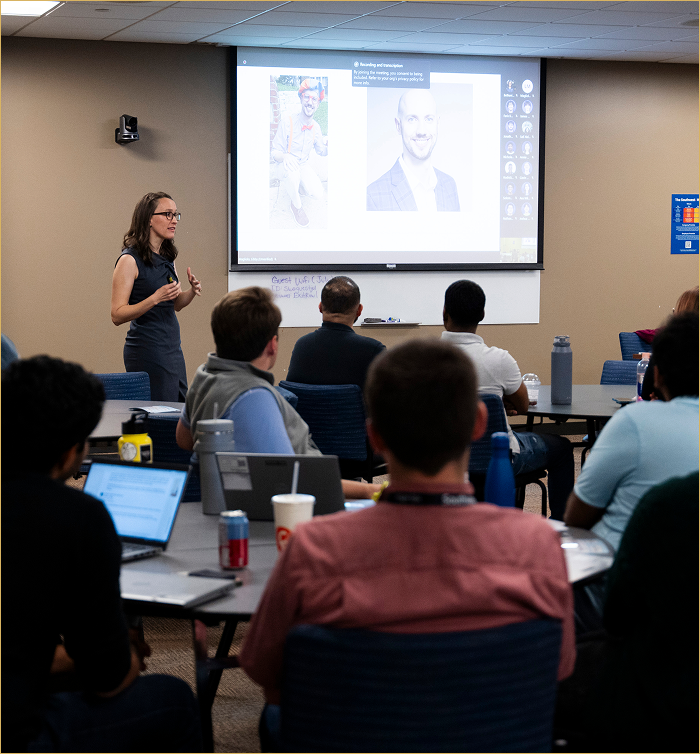


Libby is fun, engaging, and understands how to make sure everyone gets it. I’ve been fortunate enough to attend a few of her training sessions, and even with a public speaking background, I learn something new every time!
—Tania Kadar

This Problem is Common.
It is Also Fixable.

Most professionals have never been given a repeatable process for deciding what belongs in the presentation, what belongs on the slide and what belongs in the conversation. Once they have one, the quality of the work changes quickly.
This Problem is Common.
It is Also Fixable.
Most professionals have never been given a repeatable process for deciding what belongs in the presentation, what belongs on the slide and what belongs in the conversation. Once they have one, the quality of the work changes quickly.











What This Training Covers
Everything in the workshop fits into a simple, repeatable framework your team can use on the next presentation and every one after it: Define. Design. Deliver.
DEFINE:
Decide What Matters and Organize the Story.
Before we worry about design, we get the message right. We ask:
What does this audience need to know?
What do they already know?
What do you want them to understand, decide or do when you're finished?
And, perhaps most importantly:
What can you leave out?
Participants learn how to curate information rather than simply collect it.
A presentation shouldn't feel like a series of slides that happen to be about the same topic.
We'll work on organizing information so the audience can see where the story is going and why each piece matters.
That includes getting to the point earlier, structuring supporting information and making the recommendation crystal clear.
DEFINE:
Decide What Matters and Organize the Story.
Before we worry about design, we get the message right. We ask:
What does this audience need to know?
What do they already know?
What do you want them to understand, decide or do when you're finished?
And, perhaps most importantly:
What can you leave out?
Participants learn how to curate information rather than simply collect it.
A presentation shouldn't feel like a series of slides that happen to be about the same topic.
We'll work on organizing information so the audience can see where the story is going and why each piece matters.
That includes getting to the point earlier, structuring supporting information and making the recommendation crystal clear.
DEFINE:
Decide What Matters and Organize the Story.
Before we worry about design, we get the message right. We ask:
What does this audience need to know?
What do they already know?
What do you want them to understand, decide or do when you're finished?
And, perhaps most importantly:
What can you leave out?
Participants learn how to curate information rather than simply collect it.
A presentation shouldn't feel like a series of slides that happen to be about the same topic.
We'll work on organizing information so the audience can see where the story is going and why each piece matters.
That includes getting to the point earlier, structuring supporting information and making the recommendation crystal clear.
What I Hope
Changes Afterward
I don't expect your employees to start obsessing over presentations the way I do.
That would be weird.
I do want them to approach the next one differently.
I want them to stop and ask what the audience actually needs before opening PowerPoint.
I want them to recognize when they're giving someone every piece of information instead of the right information.
I want them to know how to simplify a slide instead of just making the font smaller.
I want them to be able to say:
"The point of this presentation is…"
And then actually build the presentation around that point.
That's what success looks like.

That is Also Why the Package Doesn't End When the Workshop Does.
Participants leave with the workbook, examples and tools, and the team gets a follow-up office hour where people can bring actual work and ask:
"Okay, how do I apply this to mine?"
For organizations that want repeated practice, individual feedback or deeper skill development, I offer expanded half-day, full-day and multi-session programs.
But you do not need one of those to get started.
$4,500
/ up to 15 participants
No surprise curriculum-development fee.
No weeks of meetings before the training.
No 27-question needs assessment.
I'll ask you a handful of useful questions, we'll have a short planning conversation, and I'll take it from there.
What Comes With
the Workshop
The standard Presenting at the Executive Level package is $4,500 for up to 15 participants.
That includes the live two-hour session, participant workbook, digital slide bank, planning tools, 30 days of access to supplemental resources and a 60-minute group office hour after the workshop.
It can be delivered virtually or onsite.
For onsite engagements outside Dallas–Fort Worth, travel expenses are additional.
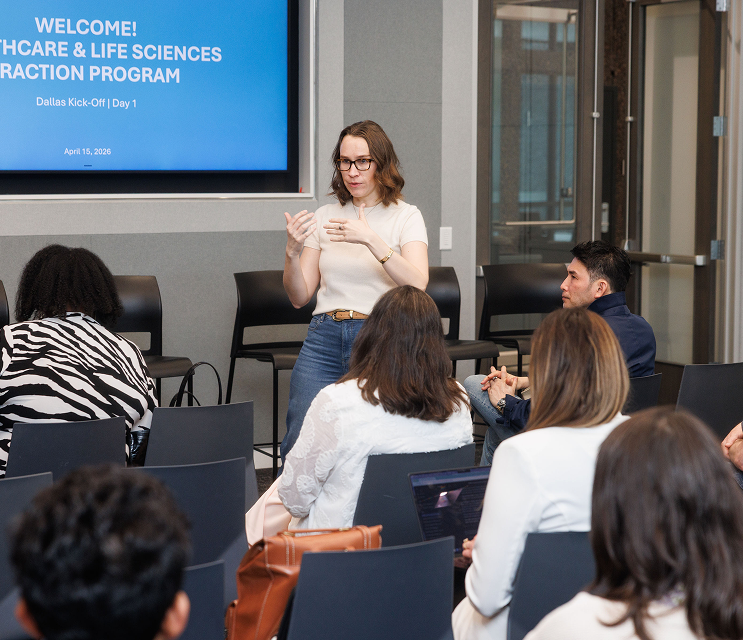
A Little About MeHi, I'm Libby.
I'm the founder of The Slide Master and a longtime presentation nerd.
My management consulting background gave me a crash course in taking complicated information and turning it into clear presentations for high-stakes conversations.
Later, I realized that most professionals are expected to do exactly that throughout their careers. Almost nobody teaches them how.
So I do.
I've worked with corporate audiences ranging from early-career professionals to senior leaders, and I also teach MBA students.
My training style is practical, highly interactive and built for people who have actual jobs to get back to.
I care much less about whether someone can recite one of my frameworks a month later than whether their next presentation is better because of it.